
料理仙姬
China’s chip exports nearly double in Jan-Jul; ‘New new three’ products to fuel continued export growth_我的网站

一 |
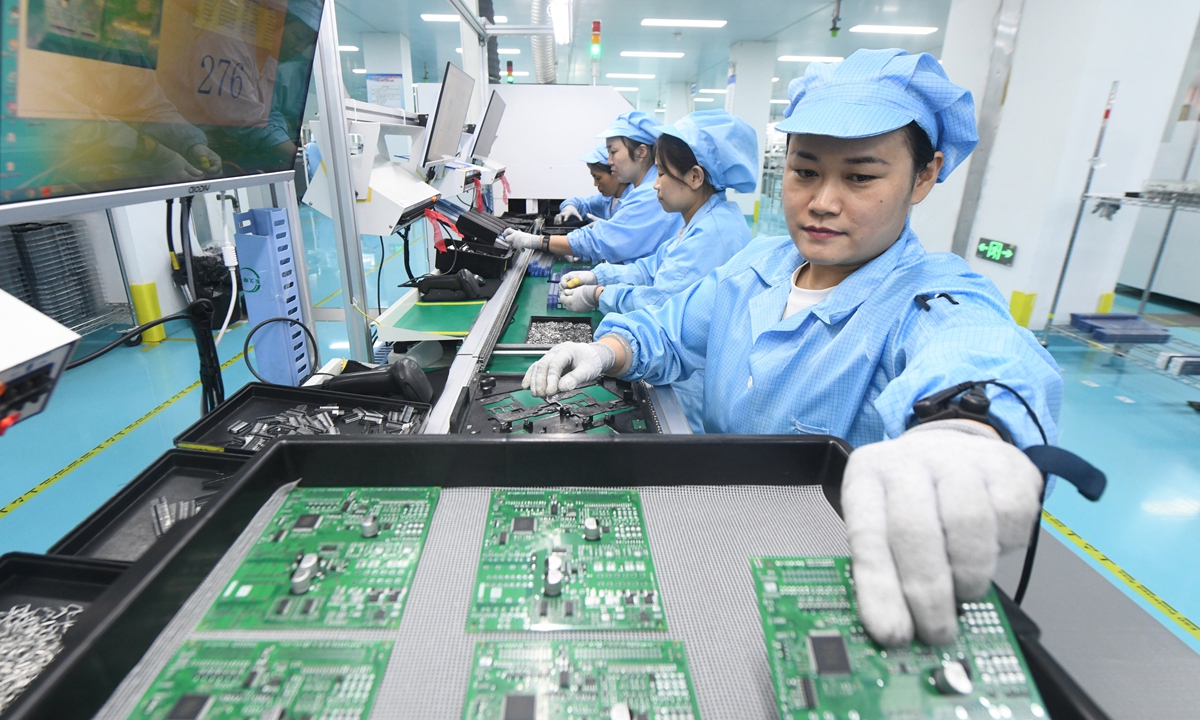
China's exports of integrated circuits (ICs) reached $216.02 billion in the first seven months of 2026, up 99.5 percent year-on-year, according to data released by the General Administration of Customs (GAC) on Friday.
Chinese experts said that rising global artificial intelligence (AI) demand is a factor, but the main drivers of the leap in chip exports are the country's technological breakthroughs and upgraded industrial chain.
The robust growth in IC exports also came as China's overall foreign trade saw stable expansion. According to data released by the GAC, the sound upward trend in China's foreign trade continued in July, with growth of 19.2 percent year-on-year to reach 4.66 trillion yuan ($686.26 billion), remaining above 4 trillion yuan for the fifth consecutive month.
In the first seven months of the year, total foreign trade in goods amounted to 30.13 trillion yuan, up 17.3 percent year-on-year, the data showed.
"Since the start of this year, China's economy has forged ahead against headwinds and moved toward innovation-driven, higher-quality development, providing strong underpinning for the growth of foreign trade," said Lü Daliang, an official with the GAC.
According to the GAC, China's exports of electromechanical products reached 11.12 trillion yuan between January and July, up 21.2 percent year-on-year. They accounted for 63.8 percent of the country's total exports, up 3.8 percentage points on a yearly basis.
There was notable progress in green and low-carbon products, with exports of electric vehicles (EVs) and lithium batteries rising by 71.2 percent and 35.8 percent, respectively, while exports of 3D printers soared by 110 percent, with industrial robots jumping 13.2 percent and ships 32.7 percent.
"The surge in China's chip exports reflects breakthroughs in multiple aspects," Fu Liang, a Beijing-based tech analyst, told the Global Times on Friday. Fu pointed to a rise in mature-node capacity, industrial and supply chain resilience, and scale production advantages of Chinese companies.
As demand for chips in automotive electronics, industrial control systems, and household appliances keeps rising, China-made mature-process chips - backed by reliable supply capability and strong cost-performance - have become an indispensable link in the global supply chain, Fu said.
Meanwhile, there has been an upgrade in China's chipmaking industry, such as the new chip design approach at Huawei based on the company's Tau Scaling Law, and the international competitiveness of China-made chips is expected to increase, supporting further growth in exports, the expert noted.
China recently issued a revised regulation on protection of IC layout-designs. Scheduled to take effect on October 15 this year, the regulation aims to strengthen the protection and application of layout-designs, and improve registration and management systems by elevating proven practices into regulations, while also aligning with relevant laws and international treaties.
These institutional upgrades are unfolding alongside broader efforts to expand domestic demand and open the Chinese market wider to the world. China has also accelerated imports in the first seven months of this year to promote a more balanced development of foreign trade. China has remained the world's second-largest import market for 17 consecutive years. In the first seven months of 2026, China's import growth outpaced export growth by 8 percentage points, according to the GAC.
In addition, China's imports and exports with over 180 countries and regions registered growth over the period. Specifically, the country's trade with ASEAN, the EU, Latin America, and Africa rose by 20 percent, 9.5 percent, 15.4 percent, and 18.9 percent year-on-year, respectively. Trade with the US, however, fell by 1.6 percent, with the decline narrowing by 2 percentage points compared with the first half of the year, according to the GAC.
Amid a complex external environment, China has leveraged its complete industrial chain to accelerate trade structure upgrading, driving brisk growth in both imports and exports, Wen Bin, chief economist of China Minsheng Bank, told the Global Times.
Although China's foreign trade sector still faces pressure in the second half of the year, Wen said the same fundamentals are still supporting China's export growth: the competitiveness of China's "new new three" products, the ongoing AI investment cycle, plus a raft of domestic risk-mitigation policies covering forex, fiscal and customs.
"China's export sector is projected to hold onto double-digit growth in the second half of the year," he said.
。 On Ram Navami, a festival that celebrates the birth of Lord Ram , the Navmi day of the chaitra Navratri and the enduring values of devotion and righteousness, Narendra Modi chose to share more than a customary greeting. His post featuring the devotional song “Maay Bhavani” brought a sense of spiritual depth to the occasion, reminding listeners of the quiet power of music rooted in faith. The song, from the Marathi film Shahbaz Sunbai, belongs to a time when cinema and music were deeply intertwined with cultural and devotional expression. Its composition by Meena Mangeshkar Khadikar carries a sincerity that avoids excess, allowing the essence of devotion to take centre stage. In an era of fleeting soundscapes, such compositions stand apart for their stillness and emotional clarity. It is, however, the voice of Lata Mangeshkar that celebrates “Maay Bhavani” into something timeless. Her music has long defined the emotional memory of India, moving effortlessly between romance, melancholy, and devotion. In songs of a spiritual nature, her voice often feels less like performance and more like prayer, marked by an almost meditative purity. This quality lends the composition a rare depth, making it especially fitting for a day like Ram Navami, where devotion is both personal and collective. For authors Rachna Shah and Rhythm Wagholikar, the moment carried a deeply personal resonance. Responding to the Prime Minister’s post, they shared a note that captured both gratitude and memory, offering readers a glimpse into the story behind the song. Their note is reproduced here in full: ⸻ Dear friends, It’s so heartwarming to see our honourable Prime Minister Shri. Narendra Modiji post a song on Maa Ambe - Maay Bhavani, on the auspicious day of Ram Navami. The striking part is that this song is composed by my mother Meena Mangeshkar Khadikar and sung by my aunt Lata Mangeshkar.. We just chatted with Aai and told her regarding this post. She shared an interesting behind-the-scene story. This song was originally to be composed by Lata didi herself, however during those days, Didi was overwhelmed with the work load and couldn’t dedicate the time required. So, she requested her sister Meena to step in and do the needful. Meena Mangeshkar Khadikar was an established composer and took charge and this composition took its birth… This post by our beloved Prime Minister opened up a floodgate of beautiful memories and with our heartfelt sentiments we stand in gratitude. Warm regards, Rachana Rhythm ⸻ What emerges from this reflection is a story of artistic trust and familial bond. The decision by Lata Mangeshkar to pass on the responsibility of composition to her sister reveals not just the pressures of her time, but also the quiet confidence she had in Meena Mangeshkar Khadikar’s musical sensibility. It is in such moments that enduring art often finds its form. The Prime Minister’s gesture, therefore, does more than revive a song. It reconnects audiences with a legacy, one that spans generations and continues to shape India’s cultural identity. For Rachna Shah and Rhythm Wagholikar, it is a moment of remembrance and gratitude. For listeners, it is an invitation to rediscover a melody that carries both devotion and history within it. Also Read: Sharda Sinha: A Voice That Became The Prayer of The Soil。

二 |
Current article:http://www.chuandanfozhuanbenglipaicuzi.pics/list_7137/opg2.docx
Published on:04:43:34
我的网站最新文章
- 让翠竹拥有“国家标准底色”,大亚圣象主导《竹木复合层积地板》修订
- 勝俣州和『旅サラダ』ゲストに対し「体重が重いから」発言で疑問噴出 一般人にも“体型イジり”で懸念される“茶化し芸”
- 浙江荣泰电工器材股份有限公司递表港交所
- 电讯报谈莱斯特内部动荡:范尼更衣室遇到问题,训练场被称度假村
- 罗马诺:摩纳哥有意签热刺中场萨尔,双方目前正在谈判
- 资金层面出现三个降温信号
- 本地制造企业出海新增一条家门口物流通道 集装箱经内河航道就能直发乍浦港中转出口
- Philippine military ordered to stop using AI apps due to security risks
- 日本探险游戏《Rain98》亮相韩国BIC 2026展
- PM to address 90th Interpol General Assembly on Tuesday
- 助走失老人平安回家
- 三年建100吉瓦光伏!印尼总统放豪言:未来无需进口石油
- 西班牙队获5000万美元冠军奖金,2026年世界杯各队奖金一览
我的网站随机推荐
- 航司购票新增“超售让座,立减50” 真能解决超售难题吗?
- 全省城市供热采暖工作电视电话会议召开
- 2026十大高返利app:返利APP帮你把每笔支出用出价值
- 三星秀微LED巨无霸电视:震撼,又大又贵
- 苹果VR部门大裁员,VisionPro 2真悬了
- 情定西湖 蒋庄婚姻登记处启用一周年
- 对中东地缘冲突担忧缓解,国际油价25日显著下跌,当日收盘时下跌超3%
- 二手电商要“变天”?多家平台瞄准以旧换新
- No Happy Ending: Iconic Walrus Freya Euthanized in Norway
- Shanghai sci-tech museum welcomes 100 millionth visitor amid tech travel boom
- 华泰证券A股策略:布局盈利与筹码的“配置差”
- 형 사망 후 드러난 '친자 불일치'…"조카가 재산 물려받나요?"
- 《大航海时代:凯旋航线》首测收官在即,明晚直播共话新航程