模范秘书
What does this reunion in Maowusu Desert mean?_我的网站

A |
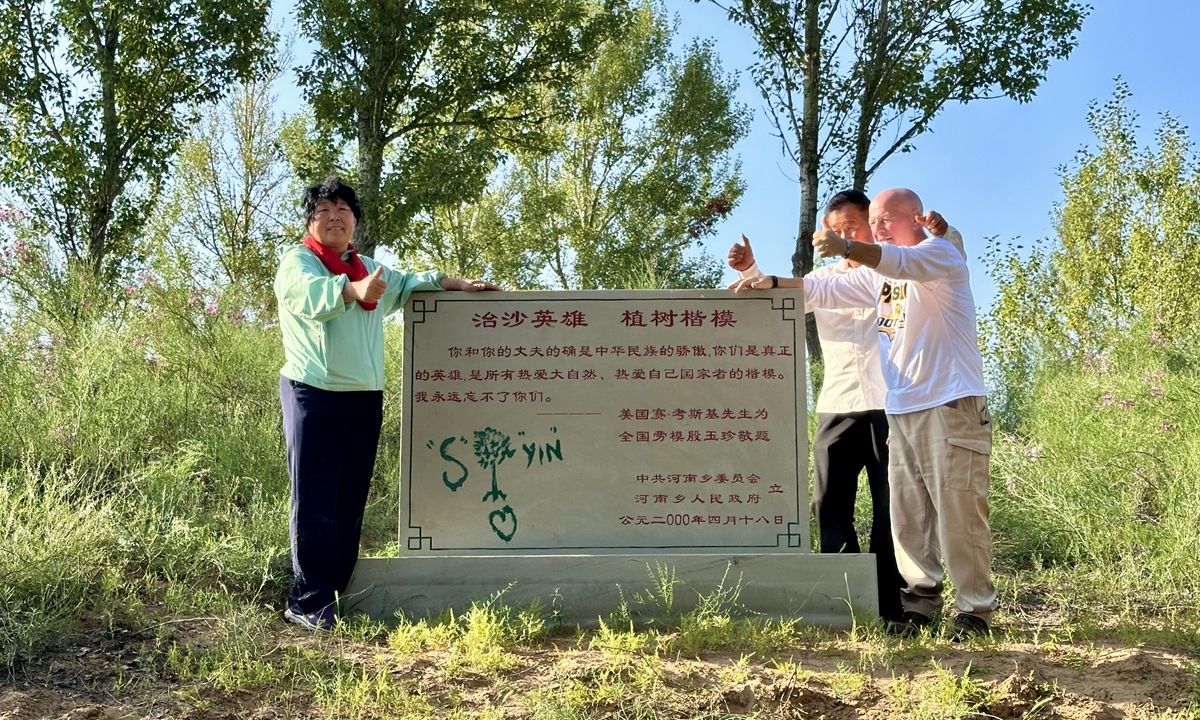
Yin Yuzhen (left), Ronald Sakolsky (right) and Yin’s husband pose for a photo in Ordos, North China’s Inner Mongolia Autonomous Region, on August 24. Photo: Lin Xiaoyi/GT
At the Ordos Ejin Horo International Airport in Ordos, North China’s Inner Mongolia Autonomous Region, Yin Yuzhen, a nationally recognized hero in desertification prevention and control and her US friend “Sai Kaosi” (whose real name is Ronald Sakolsky) embraced each other in tears.
This reunion after 26 years, spanning the Pacific Ocean, took place as scheduled under the witness of the lush greenery of the Maowusu Desert, touching the hearts of countless people around the world.
This reunion across mountains and seas was not only a long-awaited gathering of two old friends, but also a vivid testament to how goodwill can take root, how people can work together in desertification control, and how people to people friendship can endure.
This reunion was a beautiful echo of goodwill transcending time.
Twenty-seven years ago, Sakolsky, who was teaching in China, was deeply moved by the story of rural woman Yin’s efforts to combat desertification and curb the spread of sand. He selflessly donated $5,000 to support her efforts and traveled specially to the Maowusu Desert in Wushen Banner the following spring to visit and encourage her.
Yin kept this assistance firmly in her heart and repaid it by planting trees. As seasons came and went, 50,000 saplings, together with precious goodwill and trust, took root in the Maowusu Desert and grew into towering trees.
Yin’s repayment was not a return of material wealth, but the transformation of a profound goodwill that crossed national borders into patches of greenery deep in the desert through her day-after-day sweat and perseverance.
This reunion highlighted the tremendous power of people planting trees together until forests grow.
Yin’s life is a history of struggle against wind and sand. At the age of 19, she married into the Maowusu Desert, where wind and sand blocked her door overnight. The rural woman made the solemn vow, “I would rather die from exhaustion planting trees than let the sand overwhelm me.” She fought scorching heat and drought, battled strong winds and raging sand, and worked tirelessly for decades, eventually turning more than 70,000 mu (4 666.67 hectares) of desert into an oasis.
Sakolsky extended a helping hand and provided strong support because he was deeply moved by Yin’s desertification control efforts. Two ordinary people joined hands in tree planting and desert control because of their shared aspiration for greenery.
Countless ordinary people like them, carrying enthusiasm, keeping their feet on the ground and devoting themselves wholeheartedly, have gathered the great strength of many people planting trees until forests emerge, transforming landscapes and creating miracles in the world.
This reunion demonstrated the enduring contemporary value of people-to-people exchanges. A faded group photo, more than 20 years of never forgetting, a nationwide effort to search for someone, and a journey across the ocean to meet again – the friendship between Yin and Sakolsky is rooted in the recognition and respect between ordinary people, simple yet deeply moving. Friendship, which derives from close contact between the people, holds the key to sound state-to-state relations.
People from different countries have different cultural backgrounds, but they share the same love for the planet we call home, the same aspiration for lucid waters and lush mountains, the same pursuit of a better life, the same appreciation for every bit of goodwill, and the same cherishing of sincere friendship. Just as Yin carefully tended the saplings planted in the desert, nurturing this bond of affinity and understanding among people with sincerity will enable it to grow ever stronger and more resilient despite winds and sands.
This reunion provided a vivid example of “jointly building a community of life for man and nature.” For humanity to achieve better survival and development, it must carry out desertification prevention and control. Through a lifetime of arduous efforts, Yin brought about a green transformation in a corner of the Maowusu Desert, serving as a microcosm of China’s desertification prevention and control efforts.
As one of the countries most severely affected by desertification in the world, China has continued its efforts in desertification control for more than half a century, achieving a historic transformation from “sand advances, people retreat” to “green advances, sand retreats” with both desertified land and sandy land areas continuously decreasing.
As a foreign friend, Sakolsky, driven by the simple belief that “humanity has only one Earth, which is our common home, and we should all cherish it,” resolutely supported Yin’s desertification control efforts. Through his actions, he has shown us that protecting the ecological environment is a common cause of all humanity – by working together and supporting each other, humanity will surely be able to leave a clean and beautiful world for future generations.
Deep in the Maowusu Desert, plants and trees remain silent, yet they represent the most touching language through which humanity and nature, and humanity and the world, communicate with each other. This place is not only a shining answer sheet for China’s ecological civilization development, but also a warm example for global desertification control through extensive international exchanges and cooperation in jointly creating more greenery.
From $5,000 to 50,000 towering trees, from a landscape once covered by wind and sand to vast stretches of lush green, from the other side of the Pacific Ocean to the depths of the Maowusu Desert, the reunion between Yin and Sakolsky inspires us that goodwill can transcend mountains and seas, perseverance can transform deserts, and mutual understanding between hearts can eliminate prejudice and barriers.
Living together in the global village, if people from all countries show more sincere empathy, work together with one heart, stay grounded and move toward each other, they will surely be able to jointly protect the common home on which we depend for survival and cultivate more green shade of friendship and hope.
This was compiled and translated by the Global Times English edition based on an article published in the quick comment on economic hotspots column of the People's Daily on August 24, 2026.。 一到夏天,蛇类进入了活跃期,城市绿化带、下水道或居民院落等阴凉地都成了蛇的藏身之处。

B | 近段时间,杭州市消防救援支队忙个不停,接警抓蛇的救援越来越多。

C | 杭州滨江区消防救援大队浦沿消防救援站前不久接到市民报警。据报警人讲述,自己在家的时候,突然听到房间里传来巨响。

D | 跑进去一看,一条大蛇掉在地上,目测有一公斤重,因为害怕不敢靠近,赶紧打119求助。

E | 消防员穿戴防护装备后分工配合,一名救援人员使用捕蛇钳稳稳固定蛇身将其牵出,另一名队员做好防护紧抓蛇头,两人默契配合将大蛇安全收纳进蛇袋,成功消除居民家中险情。

F | 无独有偶,临平区乔司消防救援站近期也接到市民报警,称家里闯进了一条蛇。

G | 消防员抵达现场后,在杂物堆下发现了那条蛇,这是一条无毒的黑眉锦蛇。消防员刚用捕蛇钳将蛇抓捕,又在杂物下发现一条蛇。没想到,当他们收拾器材准备离开时,发现了第三条蛇。

H | 幸好,这三条蛇都是无毒的黑眉锦蛇。除住宅外,厂区、车辆内也成为蛇类出没的重点区域。7月26日,滨江某小区一辆电动车下方出现一条蛇,初步判断是小区居民饲养的宠物蟒出逃;5月22日,临平区崇贤街道大安村三信工业园的一个角落里,两条菜花蛇盘在被塑料袋包裹的报废排烟机里;5月15日,临平区塘栖镇泰山村村民,发现停在院子里的车内钻进一条蛇,躲在车头深处不出来。杭州市森保中心工作人员告诉记者,消防员处理的黑眉锦蛇和菜花蛇都是杭州比较常见的无毒蛇。除此以外,背脊有两条纵贯全身黑线的乌梢蛇、具有红黑相间鲜艳体色的赤链蛇也是常见的无毒蛇。而五步蛇、短尾蝮、福建竹叶青、舟山眼镜蛇等是比较常见的毒蛇,被咬后严重的话会导致肢体坏死、呼吸困难等后果。

I | ■小贴士如何科学防蛇在家中,要物理封堵和清除栖息地“双管齐下”。在户外则要尽量避免夜间在山林区域活动,尤其是草木茂盛的地方。

J | 发现蛇类,要保持3~5米安全距离,缓慢后退离开,不要转身狂奔;室内发现蛇可关闭房门隔离,立刻拨打119,由消防专业人员抓捕放生。万一被毒蛇咬伤,要冷静应对,缓慢离开事发地,防止二次咬伤,平躺休息;远距离拍摄蛇的全貌,便于医院匹配对应抗蛇毒血清;接着摘除束缚物、伤肢低位固定、冲洗伤口、进行绑扎,做完这些后,立即就医。蛇伤救治医疗机构有杭州市中医院、浙江大学医学院附属第一医院、浙江大学医学院附属第二医院、浙江省中医院、浙江省立同德医院等,可就近前往。
Current article:http://www.chuandanfozhuanbenglipaicuzi.pics/news/20260826_6764.doc
Published on:11:05:41


